
Due diligence orchestration mode
Every financial institution has a target operating model, so how financial institutions orchestrate their work varies considerably. Target operating models range in complexity based on some of the following factors:
- Financial segments served: One or more segments, such as Retail, Commercial, and Wealth, each with different complexities.
- Geographic reach: Single jurisdiction, regional, or truly global.
- Product offerings: Certain products, such as derivatives, attract more regulatory due diligence.
The operating models change over time as operations evolve. The Pega CLM and KYC application provides preconfigured modes of due diligence orchestration to meet the financial institution's needs. Each mode offers various Cases, questionnaires that each of those Cases displays, and a different operating model that drives the distribution of the work.
Due diligence orchestration modes
Due diligence orchestration has three preconfigured modes: Standard, Intermediate, and Simplified.
Mode 1: Standard
The Standard mode is suitable for businesses that must handle the highest levels of complexity to serve customers. Such businesses are typically large global operators that serve a wide array of customers in market segments, such as Corporate and Investment Banking. The mix of products that the business offers is typically heavily regulated.
In the following image, click the + icons to learn more about the Standard mode:
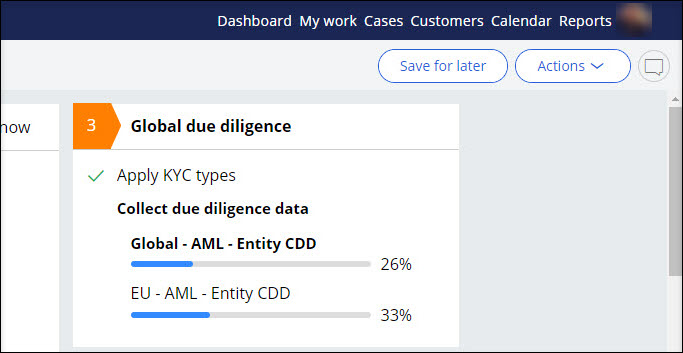
In the Standard mode, the application generates a Global KYC Case for global and regional AML questionnaires. Separate Local KYC Cases that are created show Local AML questionnaires for each jurisdiction of the product. The following figure shows a Global KYC Case which only displays the global (Global - AML - Entity CDD) and regional (EU - AML - Entity CDD) questionnaires. For example, the Local AML questionnaires for the US and Belgium are in separate Local KYC Cases.
The Cases outlined in this mode are routed through the highest number of departments, including Global Due Diligence, FATCA, and CRS, as well as separate departments for each Local AML and Product regulation jurisdiction.
Mode 2: Intermediate
The Intermediate mode is best suited for businesses with lesser complexity needs than the Standard mode but both still run large operations. An intermediate business type may focus on a single region but still maintain a reasonable number of jurisdictions. The product offerings are typically reduced but still include some regulated products.
In the following image, click the + icons to learn more about the Intermediate mode:
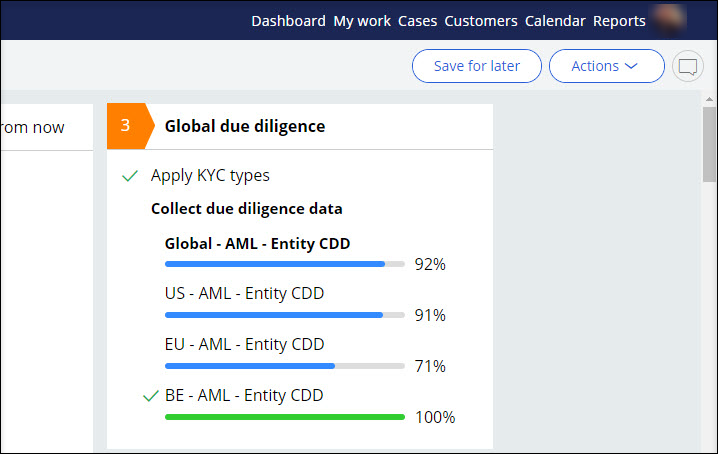
In the Intermediate mode, a single Global KYC Case displays all AML questionnaires for the customer. In the following figure, Local AML questionnaires for the US (US - AML - Entity CDD) and Belgium (BE - AML - Entity CDD) are displayed together in the Global due diligence Case:
The Cases that are outlined in the Intermediate mode are routed through a smaller number of departments than the Standard mode. For example, all AML due diligence work is routed through a single AML department. The Regulatory and Tax departments handle their own activities.
Mode 3: Simplified
The Simplified mode enables a centralized approach to orchestrate the due diligence work of organizations, such as those focused on a smaller geographic area with a simpler product mix.
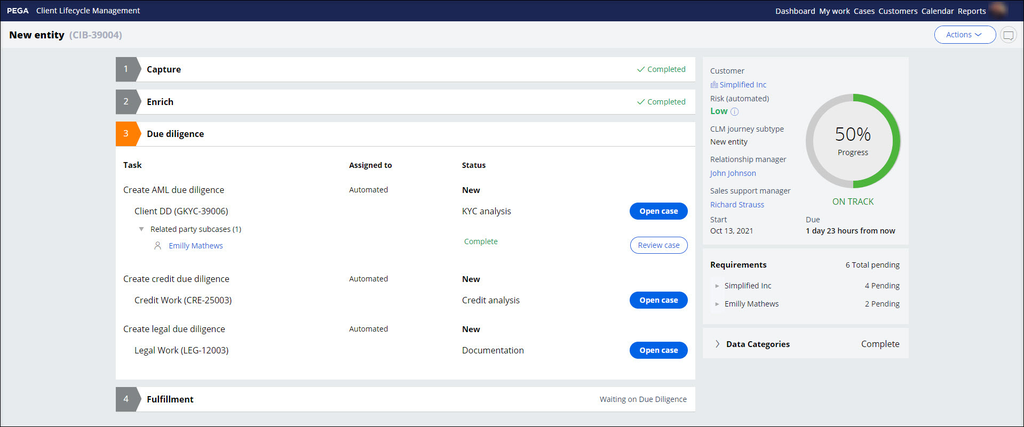
In the following example, there is a single Case to cover all AML, Product Regulatory, and Tax questionnaires for the customer. There is one Subcase for each applicable related party for handling the required Global AML questionnaires.
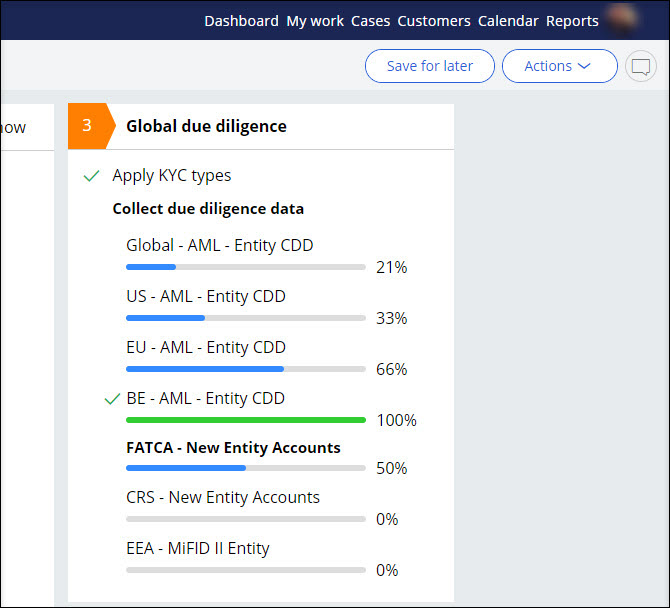
All questionnaires for the customer are displayed in the main GKYC Case, as shown in the following figure:
For the Simplified mode, a single department handles all AML, Product, and Tax Regulatory work.
Due diligence orchestration mode changes
All businesses change over time, no matter how slowly or quickly. There can be an expansion to a new region or a reduction in the number of jurisdictions served. Certain business functions may consolidate centrally or spread out to multiple regions.
As a target operating model evolves, the systems that manage the work must also easily adapt. Failure to adapt to such changes can lead to large inefficiencies and jeopardize business strategies. The Pega CLM and KYC application meets such a need for flexibility by aligning with an initial target operating model and then accommodating changes over time without any deep impact on the underlying system and ongoing work.
The mode of due diligence orchestration is easily configurable. By default, the system applies a single mode across the whole application. However, you can configure that mode to support different modes for specific business use cases. For example, you can set the Standard mode for one type of customer and Simplified for another.
The configuration brings a powerful level of flexibility in how the due diligence activities of different business use cases can vary in their orchestration.
When the orchestration mode changes, all new customer journeys are orchestrated according to the new mode. Any customer journeys in process before the change in orchestration mode are completed through the previous orchestration mode.
Due Diligence parallelization process
The Due Diligence parallelization process enhances the CLM Journey with parallel Global KYC Cases created for the Counterparty (CP) and Related Parties (RP) during the Due Diligence Stage. This parallelization makes the iterative discovery process and data synchronization between CP and RP Global KYC Cases more effective.
The Due Diligence parallelization process is compatible with individual and organizational CLM Journeys but excludes funds and fund manager Journeys.
Two modes for the Due Diligence parallelization process are available:
- : The Global KYC Case for the CP runs the CreateRelatedCases flow that creates all RP Global KYC Cases, and then waits for resolution of the Cases before starting CP due diligence. This mode is the legacy orchestration mode.
- : The Global KYC Case for the CP starts the CP due diligence step in parallel with all RP Global KYC Cases. However, the KYC Review step for the CP only starts when all RP Global KYC Cases are resolved.
In Parallel mode, the data entered propagates its effects to other Cases and Parties at the following four points:
- After the Customer Investigation of RP, which includes eScreening and Adverse Media completion.
- When Global KYC Cases for RP are resolved.
- After data change on the Manage Related Parties flow action in Global KYC Case for the CP.
- When the KYC Reviewer approves each Global KYC Case for RP.
These synchronization points ensure that the application maintains updated data across the main Case and Subcases.
Check your knowledge with the following interaction:
This Topic is available in the following Modules:
If you are having problems with your training, please review the Pega Academy Support FAQs.
Want to help us improve this content?