
Application structure
A Pega application consists of a bundle of Rules that perform a specific functionality. The design of each application focuses on a single functionality; this approach makes it a modular application. All modular applications are then stacked together (in an application structure) to fulfill business goals.
When developing an application, consider the following elements:
- Business goals and objectives
- People involved in the business process
- Data involved in the business process
- Reusable elements
Business goals determine the application to create. People and data determine where to place the application in the stack, and reusable elements help promote modular reuse architecture.
Framework and Implementation
As a Lead System Architect (LSA), you play an important role in deciding the structure of a Pega application. People, data, and reusable elements are influential factors in finalizing the application structure.
The New Application wizard provides two application structure options:
- Framework
- Implementation
A framework structure application acts as a template for constructing implementation applications. Framework applications are generally abstract and serve as blueprints for implementation applications. However, it is not a best practice to use framework applications to package the common code or Rules required across the organization. Avoid using the framework option for the sake of future-proofing. In Pega Platform™, a framework represents an entire layer by itself. Extra effort is required to build and maintain a framework application. Clear evidence is necessary to justify why a monolithic framework application or layer is necessary.
Framework structure applications can only use ORGs from the organization setting, so frameworks are always built only at the ORG layer.
An implementation structure application can refer to any type of application other than a framework structure application. An implementation application can be built on a framework application, and the term implementation application can apply to a reuse layer application that is not a framework application. The best practice is to have smaller, special-purpose implementation structure applications that are considered modular.
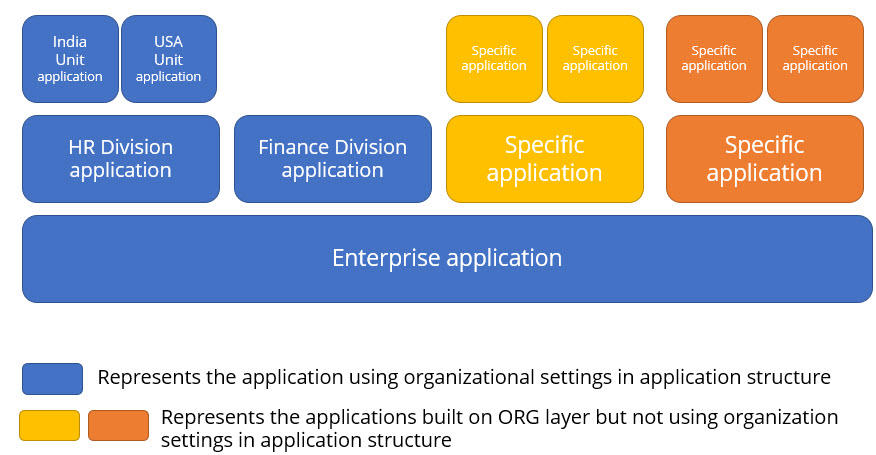
Implementation structure applications can use ORG, Division, and Unit from the organization setting to create applications for a specific line of business in the organizational hierarchy. Implementation applications can be built in different layers without including Division and Unit organization settings.
Using organizational settings helps manage access and handle line-of-business-specific assets.
The following figure shows an example of the different layers in the structure of an enterprise application:
Examples of class structure unit applications with that structure include ORG-HR-India-AppName-Work-CaseType and ORG-HR-USA-AppName-Work-CaseType.
In comparison, applications without organization settings use the ORG-AppName-Work-CaseType class at any layer.
Check your knowledge with the following interaction:
This Topic is available in the following Module:
If you are having problems with your training, please review the Pega Academy Support FAQs.
Want to help us improve this content?