

Email Bot training
Organizations today handle large volumes of incoming customer emails across multiple channels. Responding to each message accurately and quickly is a significant operational challenge. Pega Email Bot™ addresses this challenge by combining natural language processing (NLP) and case management to understand, triage, and act on customer emails — without requiring a manual response for every interaction.
For Pega Email Bot to interpret emails accurately, the underlying text analytics model must be trained to recognize different types of user input. This topic explains how training works, who is involved, and how the NLP model improves over time.
Understanding the Pega Email Bot learning process
Pega Email Bot uses NLP to analyze email content and identify patterns in the way customers communicate. Rather than matching keywords, the bot learns from longer examples — building an understanding of topics, context, and intent based on real email interactions.
The model improves with volume. As more emails are processed and more training data is added, the accuracy of email classification and entity mapping increases. This continuous learning cycle means that Pega Email Bot becomes more effective the more it is used.
For each topic configured in the email channel, the bot must be trained separately. Training involves providing example emails, manually classifying them by topic, and using those classifications to teach the NLP model how to categorize similar messages in the future.
The following figure illustrates the training process: an inbound email passes through NLP analysis, which produces a topic classification. Providing labeled examples reinforces this classification loop, improving model accuracy over time.
Customer service representative triage
Customer service representatives (CSRs) are the first line of training in a live environment. They work in the Interaction Portal, where they process incoming customer emails by triaging cases and mapping extracted information to the correct fields.
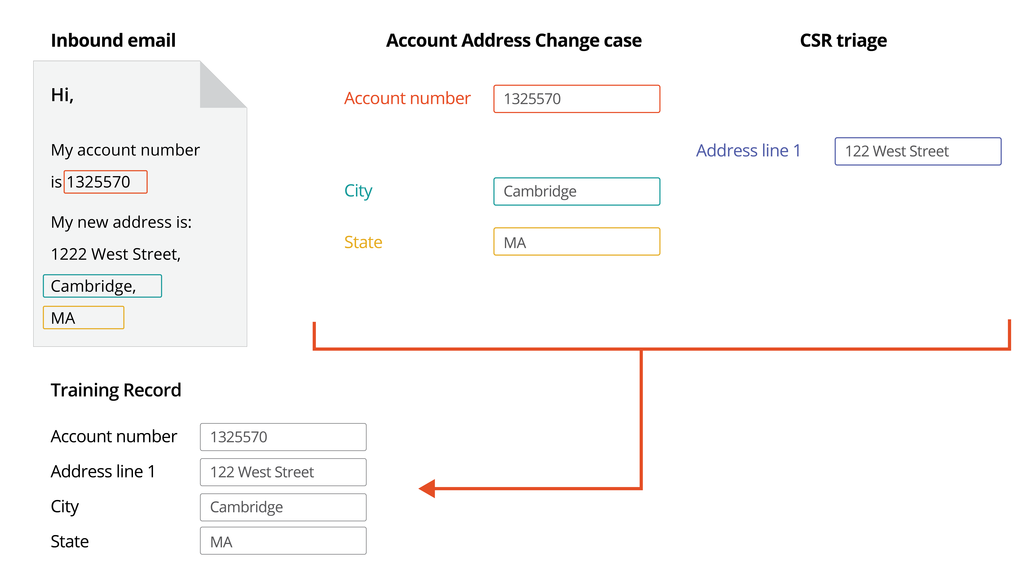
As CSRs resolve cases, they also train the model in real time. When Pega Email Bot fails to identify information correctly — for example, if it does not recognize a customer street address — the CSR can correct the mapping directly while processing the case. Each correction is automatically saved as a training record in the email channel, contributing to the ongoing improvement of the NLP model.
This approach means that training does not require a separate process. CSRs refine model accuracy as part of their standard workflow, without any additional steps.
The following figure shows an example of mapping extracted information to the correct fields:
Training record collection
The channel developer administrator manages training records in Infinity Studio. A training record contains the email content, the NLP analysis results, the mapped entities, and the associated service case. These records are the core data source used to rebuild and improve the NLP model over time.
The administrator can collect, curate, and triage records submitted by CSRs. When a CSR corrects a mapping, the system flags the resulting record as "triaged," signaling that it is ready for administrator review before being added to the training queue.
Administrators can also add training records manually. This is particularly useful during the initial setup phase, before the bot has processed a significant volume of real emails. Manual records simulate inbound emails, giving the NLP model enough examples to classify topics accurately from the start. Administrators can also import records in bulk to accelerate this process.
When the administrator is satisfied with the training data, they submit it to the queue, and the NLP model is rebuilt. Each rebuild incorporates all new and existing training records and generates an updated accuracy score. This score reflects the model's overall performance across all configured topics, giving administrators a clear indicator of model health.
This Topic is available in the following Module:
If you are having problems with your training, please review the Pega Academy Support FAQs.
Want to help us improve this content?