
Sales activities and tasks
Overview
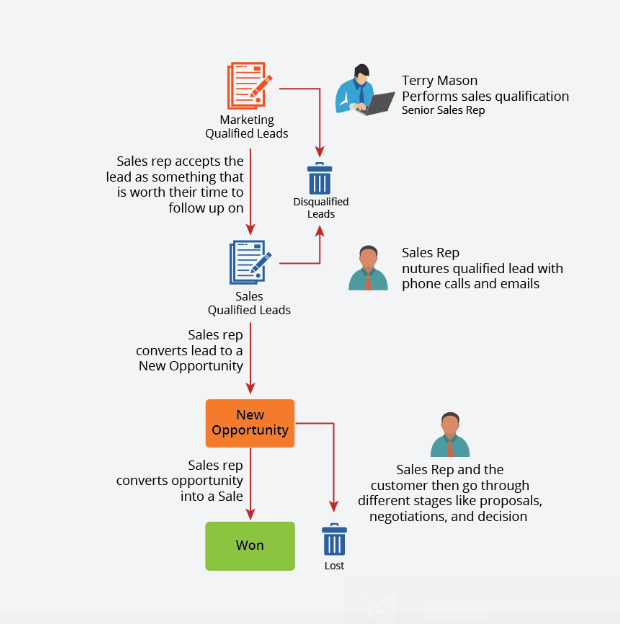
A sale begins with a lead. Leads are nurtured through customer interactions. If the locally determined criteria are met for a lead, the sales representative converts the lead to an opportunity. Sales representatives then continue to nurture the opportunity through customer interaction in an effort to win the sale.
Sales representatives create activities to capture details and outcomes of prospective customer interactions, such as phone calls and emails. Tasks are used to track to-do items, such as a reminder to send pricing information.
Activities
An activity is any meaningful communication between a sales representative and a contact that is designed to drive a sale or develop a professional relationship. An activity is related to, and can be created from, any one of the following entities:
- Account
- Contact
- Lead
- Opportunity
- Organization
Activities used to capture interactions with customers include:
- Chat
- Co-browse
- Emails
- In person
- Live meetings
- Phone
For example, when a sales representative receives a Marketing Qualified Lead, they perform sales qualification by calling the prospect. This phone call is captured as an activity. During the call, the rep learns about the prospect's business requirements and determines whether the lead meets the locally determined criteria for conversion. The activity record documents the conversation details, the prospect's responses, and the outcome of the qualification discussion.
As the sales rep continues to nurture the qualified lead, each interaction--whether an email exchange about product features, an in-person meeting to discuss solutions, or a live demo session--is captured as a separate activity. These activities create a complete interaction history that shows how the relationship develops from initial contact through opportunity creation.
Tasks
Tasks are to-do items for the sales team. Tasks have a purpose, an outcome, and an interaction date, and can have follow-up tasks. Examples of tasks include a client visit, customer communication, or other supporting activities.
For example, after qualifying a lead and identifying the prospect's interest in a specific solution, the sales representative creates a task to send pricing information by the end of the week. This task has a clear purpose (provide pricing details), an expected outcome (prospect receives information needed for decision-making), and an interaction date (the deadline for completion).
When the lead converts to an opportunity, the sales rep creates additional tasks to guide the sales process through proposals, negotiations, and decision stages. For instance, a task might be created to schedule a stakeholder meeting, prepare a customized proposal, or follow up after a presentation. Each task can have follow-up tasks--such as creating a task to send a thank-you email after a client visit, followed by another task to check in one week later for feedback.
Tasks ensure that critical sales activities don't fall through the cracks and help sales representatives manage their time effectively across multiple opportunities.
This Topic is available in the following Module:
If you are having problems with your training, please review the Pega Academy Support FAQs.
Want to help us improve this content?