
Get Next Work feature
Using the Get Next Work feature, you can configure your application to automatically select the next Assignment for the user. By choosing the most appropriate Assignment to work on next, the application promotes user productivity, timely processing, and customer satisfaction.
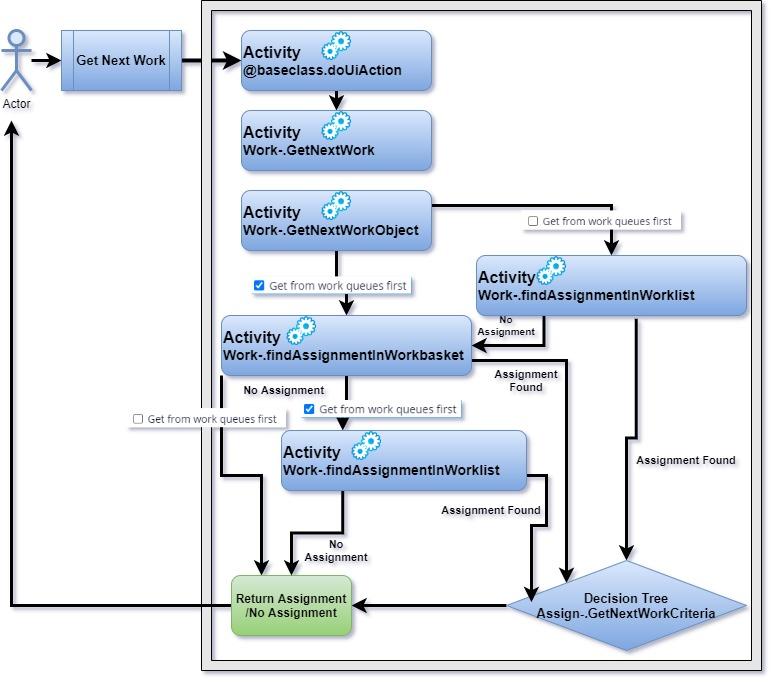
The following diagram illustrates the main activities that run when the system invokes the doUIAction activity from a browser with the action parameter set to getnextwork.
The Work-.GetNextWork activity is the entry point to the GetNextWork algorithm. Depending on the record configuration of the user, the system first searches either the user’s Worklist or the Work Queues listed on the operator record. If the system finds an Assignment, the GetNextWorkCriteria decision tree further examines the Assignment. Ultimately, the system finds an acceptable Assignment or not.
To retrieve Assignments, users typically click Next assignment in the User Portal. This action triggers an activity that retrieves Assignments. The application calls the @baseclass.doUIAction activity, which in turn calls Work-.GetNextWork. This activity immediately calls Work-.getNextWorkObject.
The subsequent steps depend on the configuration of the operator record of the user. If the user does not select Get from work queues first, the system invokes Work-.findAssignmentInWorklist activity. If the system cannot find any Assignment, it invokes the Work-.findAssignmentInWorkbasket activity. If the user selects Get from work queues first, the system invokes Work-.findAssignmentInWorkbasket activity. If the system cannot find any Work Queue Assignment, it invokes the Work-.findAssignmentInWorklist activity.
The Work-.findAssignmentInWorklist and Work-.findAssignmentInWorkbasket activities retrieve Assignments by using the Assign-Worklist.GetNextWork and Assign-WorkBasket.GetNextWork list Views, respectively.
The following figure shows the area in an operator record where Work Queues are displayed in a specific order. The activities use the Urgency Threshold value during the first pass through the list. The urgency of the Assignment must be above the listed threshold to qualify for consideration. If a second pass is required, the activities ignore the threshold value.
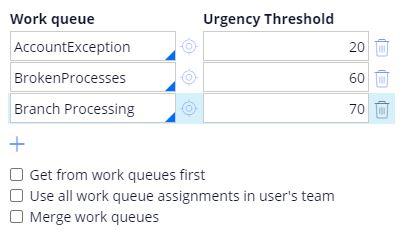
When multiple Work Queues are on the operator record of a user, the system processes the Work Queues from top to bottom. If you configure an Urgency Threshold for the Work Queue, the system prioritizes Assignments with an urgency above the defined threshold. The system considers lower-urgency Assignments only after all applicable Work Queues are emptied of assignments with an urgency above the threshold. When users select Merge work queues, the system treats the listed Work Queues as a single Work Queue, sort by Assignment Urgency, and returns the most urgent Assignment in any Work Queue.
Instead of specifying the Work Queues from which to retrieve work, you can select the Use all work queues assignments in the team option of the user to include all Work Queues that belong to the same Work Group as the user. When using this option, exclude Work Queue Assignments that the system uses to wait for the completion of Subcases.
The following figure shows the area in the Rule form of the Assignment with the Assignment routing settings. Here, Custom is the active selection, which permits the user to specify whether to route to a Worklist or Work Queue, followed by naming a routing activity. The specified routing activity is ToSkilledWorkbasket.
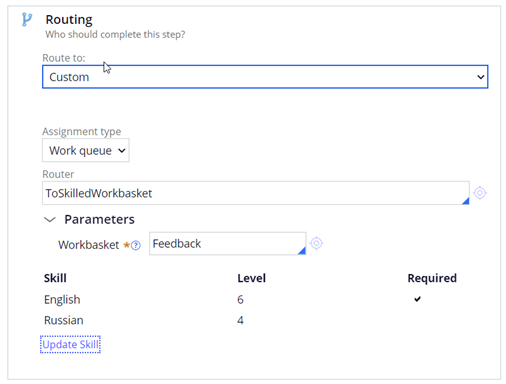
If you configure the Case to route by using the ToSkilledWorkbasket router, then the system considers the skills defined on the operator record of the user when retrieving the next Assignment. An Assignment can have both required and desired skills. The Get Next Work functionality considers only required skills.
Operator skills considered by Get Next Work
When Get Next Work runs in combination with ToSkilledWorkbasket routing, the system evaluates the skills defined on the operator record to determine whether an Assignment is eligible for retrieval. Assignments routed to a skilled Workbasket can specify both required and desired skills. During Get Next Work processing, the system considers only required skills when selecting the next Assignment.
You define operator skills on the operator record by specifying a skill name and a rating level. Rating levels represent proficiency and use numeric values. Get Next Work ensures that users can retrieve an Assignment from a Workbasket only when they have all required skills with ratings that meet or exceed the values specified on the assignment.
The following figure shows an example of possible operator Skill and Rating level for that skill on a scale of 1 to 10. Here, each skill represents a language with which the Case worker is familiar.
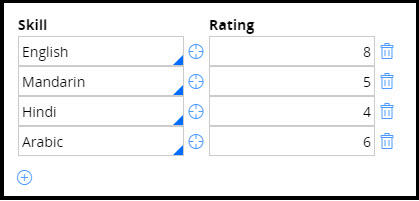
You define the user's skills by completing the Skill and Rating fields on the operator record. Skills are stored in the pySkills property on the OperatorID page. Skills checking is not performed when users fetch work from their own worklist because they would not own an Assignment without the proper skills. The Get Next Work functionality ensures that users can only retrieve Assignments from the workbasket if they have all the required skills with at least the defined ratings.
The Assign-Worklist.GetNextWork list uses the default getContent activity to retrieve Assignments. The Assign-WorkBasket.GetNextWork uses a custom getContent activity called getContentForGetNextWork to construct a query that conditionally joins with Index-AssignmentSkills and Index-OperatorSkills. The query varies based on Application setting Rules that begin with GetNextWork_. This query compares the user's skills to the Assignment's required skills, if any. Conditional joins are not possible in Listview. So, to achieve the same outcome, you can maintain multiple list Views conditionally with and without a join condition and call if you do not need to customize a GetContent activity.
Before the list view returns the Assignment, the Assign-.GetNextWorkCriteria decision tree checks whether the Assignment is ready to be worked on and if the Assignment was previously worked on by the user today. The system skips the Assignment if the user previously worked on it today.
Implementations of Get Next Work
There are two implementations of Get Next Work in Constellation:
a) Get Next Work in-Case link: Enabled in Case Type settings (the checkboxes under Assignment Processing)
b) Get Next Work button on a landing page: Enabled by configuring a landing page in the portal
a) Get Next Work in-Case link
補足: For more information, see Providing the Get Next Work link in a Case.
The Get Next Work link in a Case is a Constellation-specific feature, so those two checkboxes are not available in traditional UI applications. However, the Get Next Work button on landing pages is available in traditional UI (Theme Cosmos and UI Kit applications).
In traditional UI, developers could add the Get Next Work button to landing pages through landing page configuration, but there was no equivalent "in-Case link" feature. The in-Case link that is displayed as a banner when you finish all Assignments in a Case is an enhancement introduced with Constellation architecture.
Essentially, Constellation includes the in-Case link feature as a new way for users to access Get Next Work functionality, while maintaining support for the traditional landing page button approach that existed before. You can configure this feature in App Studio in the Case Type by selecting the two following checkboxes:
- Display custom View when no more Assignments are available for the user
- Enable Get Next Work
The following figure shows the Case Type settings in App Studio, where you can enable the Get Next Work feature in the Assignment processing section:

補足: The Display custom View when no more Assignments are available for the user option adds the Confirmation View to your Case, which is displayed when the user completes all of their assignments in a Case. You can later configure this View to display custom instructions. For more information, see Configuring a Confirmation View.
Case workers can also use the Get Next Work functionality on the Case level in a user portal when you turn on the feature in the settings of the Case Type.
The following figure shows the Get Next Work link displayed on the banner when all assignments for the current Case are complete:

For more information, see Automated and intelligent work assignment with Get Next Work.
b) Get Next Work on a landing page
A landing page can also provide access to Get Next Work, which you configure at the Portal level rather than in a Case.
Identify the Portal that contains the landing page, and then open its content configuration. In the Landing pages section, you can modify and update its setting by selecting the Enable Get Next Work checkbox.
The following figure shows how to enable the Get Next Work feature on the My Work landing page in App Studio:

Check your knowledge with the following interaction:
このトピックは、下記のモジュールにも含まれています。
トレーニングを実施中に問題が発生した場合は、Pega Academy Support FAQsをご確認ください。