
Design strategy creation
Design strategy and design thinking
During the Discover phase, determine whether design thinking activities can support your Pega Express™ project to achieve desired business outcomes. Design thinking is core to your design strategy. Planning a design strategy ensures that Center-out design is part of the fabric of your project. Your design strategy must put users (the "customers" of the solution) at the center of the application design to ensure lovability.
Design thinking starts with empathy. Empathy gives the team a solid understanding of users’ current needs, behavior, and pain points. That requires user research to provide a user perspective you can share with your team.
Consider these elements in your design strategy:
- Research – How can the delivery team learn about and understand the needs of the end-users?
- Iteration – How can the team incorporate usability testing with real people to gain early feedback and insights?
- Best practices – What best practices and design standards can the team employ while considering constraints?
Tip: Early, iterative lean usability testing helps to validate design concepts and deepen empathy by gaining continual insight into how users interact with the solution. By treating design as an integral part of the delivery, the business gains greater confidence in the adoptability and lovability of their solution. Iterative testing also reduces risk by uncovering details early on.
Design Sprint and ideation
A Design Sprint is a concentrated, collaborative set of design thinking activities that inject a burst of energy into the team, launching the project in the right direction early on.
As an alternative, an ideation session is shorter than a Design Sprint. An ideation session focuses your team on tackling a particular design activity. During Discover, design thinking activities help identify the Microjourneys™ and experiences to best address the business outcomes you are trying to achieve.
Tip: Design Sprint and ideation sessions are powerful during the Prepare and Build phases as well. The sessions help the team challenge assumptions and rethink and materially improve the Microjourney solution.
Design Sprint approach
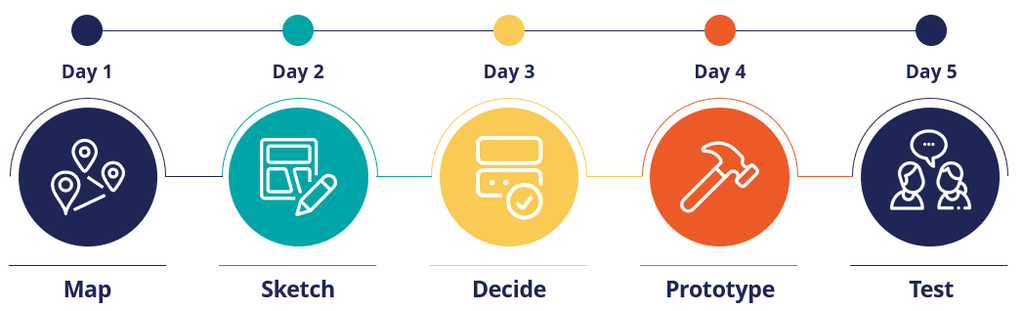
Design Sprints are multi-day events involving members of the project team who tackle business-critical problems together, achieving rapid results. What might take project teams months to accomplish is typically compressed into an intensive five-day exercise to accelerate outcomes while reducing project expenses.
Day 1: Map
Day 2: Sketch
Day 3: Decide
Day 4: Prototype
Day 5: Test
Design Sprint and your project
Note: Qualitative and quantitative data add value to your design activities or Design Sprint. Before conducting a sprint, gather data on the needs, motivations, and pain points of the business and its end users. Data and metrics inform your design and support a Design Sprint by keeping the end-user in mind as you work toward delivery.
The diagram below can help you decide to run a Design Sprint based on whether your design is known, or if you are still unclear on the design.
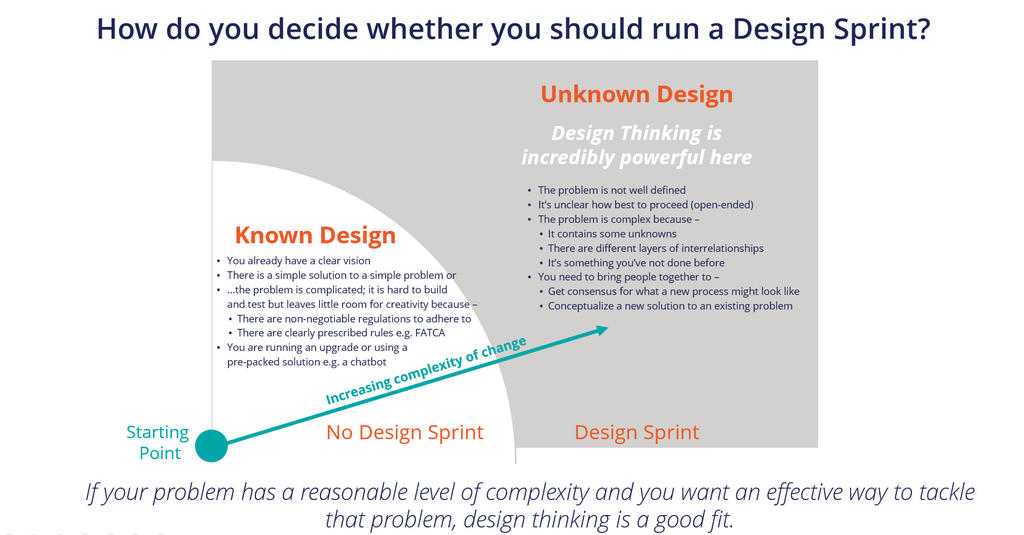
Known Design
- You already have a clear vision
- There is a simple solution to a simple problem or
- …the problem is complicated; it is hard to build and test but leaves little room for creativity because –
- There are non-negotiable regulations to adhere to
- There are clearly prescribed rules e.g. FATCA
- You are running an upgrade or using a pre-packed solution e.g. a chatbot
Unknown Design
Design Thinking is incredibly powerful here
- The problem is not well defined
- It’s unclear how best to proceed (open-ended)
- The problem is complex because –
- It contains some unknowns
- There are different layers of interrelationships
- It’s something you’ve not done before
- You need to bring people together to –
- Get consensus for what a new process might look like
- Conceptualize a new solution to an existing problem
If your problem has a reasonable level of complexity and you want an effective way to tackle that problem, design thinking is a good fit.
Design Sprint benefits
The Design Sprint pushes past the "as is" to help attendees think outside of how their organization does things today. These group events drive transformation by re-thinking journeys and reimagining great customer experiences.
You can find other tangible and intangible benefits by using Design Sprints.
- Your team can challenge assumptions and explore possibilities using innovative approaches where the strongest ideas win.
- End users confirm your ideas so that your team adapts faster to give the business confidence in your direction and affording maximum agility.
- You gain immediate insight to prioritize the most important dimensions within the application design to achieve the desired outcomes.
- Customers sit at the center of the design, which results in greater intimacy with the user and customer needs. That insight drives customer engagement and improves user adoption.
- Your entire team benefits from a real sense of momentum and ownership.
For more information on conducting a Design Sprint, view the Design Sprint criteria topic on Pega Academy.
Check your knowledge with the following interaction.
This Topic is available in the following Module:
If you are having problems with your training, please review the Pega Academy Support FAQs.
Want to help us improve this content?