
Reporting and data warehousing
To make decisions in real time or near real time, organizations often need to combine data from various sources, including web applications, legacy applications, and other sources. Business intelligence software is commonly used to collect, format, and store data, and to provide software for analyzing this data to make informed decisions.
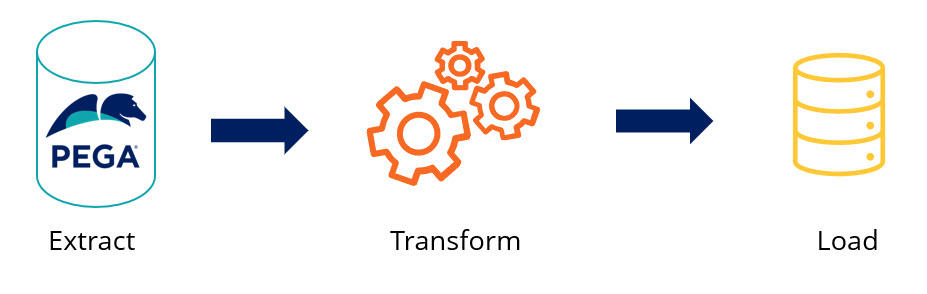
A data warehouse is a system designed for reporting and data analysis. It serves as a central repository of integrated data from one or more separate sources of data. The extract, transform, and load (ETL) process is used to prepare the data for use by the data warehouse. The following conceptual diagram illustrates a typical end-to-end process of extracting data from systems of record, storing the data in the warehouse, and then making that data available to reporting tools:
Determine whether you design your reports in your Pega Platform™ application or use an external reporting tool that impacts application performance. For example, if your reporting requirements state that you must show how many assignments are in a workbasket at any given time, you can create a report on the assignment workbasket table. If you analyze multiple years of case information to perform some trending analysis, use reporting tools suited for that purpose instead. You can link those reports from the end user portal in the Pega Platform application.
Business Intelligence Exchange
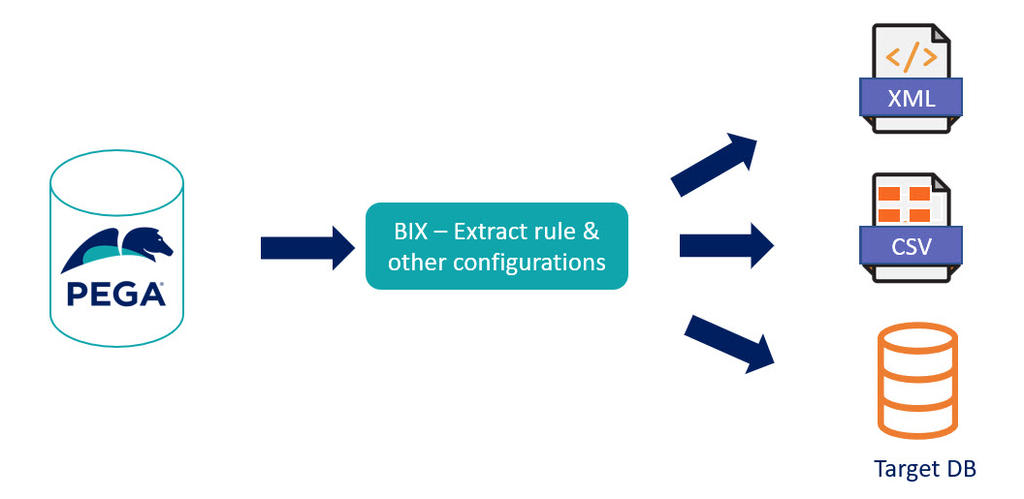
Business Intelligence Exchange (BIX) is a tool that you can use to extract data from a production application and format it for loading into a data warehouse. BIX is an optional add-on product that includes a ruleset and a standalone Java program that can be run from a command line. BIX can output data in XML or CSV formats, or it can output directly to a database. The following diagram illustrates the process of extracting data from the Pega database and preparing it for use by downstream reporting processes:
For more information about BIX, see Business Intelligence Exchange.
Check your knowledge with the following interaction:
If you are having problems with your training, please review the Pega Academy Support FAQs.
Want to help us improve this content?